

PRODUCTS
Features
Compositions: | ZrO2·Y2O3 |
Appearance: | Fiber or Formed Products |
Fiber Dia: | 3-6 um |
Purity: | ≥99.7% |
Zirconia Fiber Description
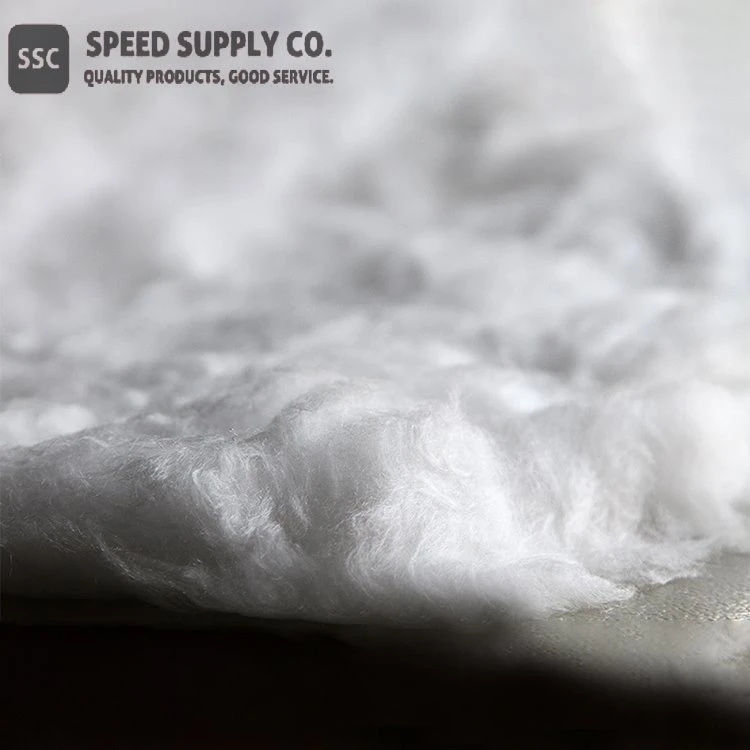
Zirconia fibre products have high temperatures strength and a high resistance against chemical agents. Zirconia fibre has the lowest thermal conductivity of any refractory fibrous products available on the market. The maximum operating temperature is 2,200℃ and the melting begins at 2,500℃ (depending on the products). The fabrics are constructed of continuous individual filaments and don't require organic binders.
There are two production methods for zirconia refractory fibers, namely colloid method and precursor method.
1. Colloid method
Add glacial acetic acid to the zirconium oxychloride solution to make it react to form white zirconium acetate precipitation, dehydrate and dry to make a zirconium acetate solution, then add a stabilizer (usually YCl3), evaporate and concentrate to make the viscosity in Colloid in the range of 5-35Pa·s, this colloid can be fiberized by centrifugal spinning method or blowing method to obtain fiber blank, the blank is dried at 100-110℃ to solidify the fiber, and then heat-treated at the required temperature. Zirconia fiber body undergoes a series of physical and chemical changes during heat treatment: physical water is removed at 100-110℃; chemically bound water and organic matter volatilization are removed at 200-300℃; zirconium salt begins to decompose at 420℃; the crystal transformation of ZrO2 occurs at 800-1000℃; the final temperature of heat treatment is 1500-1600℃.
2. Pioneer method
Soak viscose fibers (or saponified acetate fibers, polyester fibers, polyamide fibers, etc.) in a certain concentration of dilute hydrochloric acid or ethylenediamine solution to expand the fibers. It is soaked in an aqueous solution of zirconium oxychloride (or zirconium acetate, zirconium oxalate) containing YCl3 stabilizer, so that the zirconium salt enters the molecular "gap" of the organic fiber, and the surface adsorption liquid is removed by centrifugation or extrusion. The organic fiber body of the zirconium salt is placed in a furnace under specific conditions for heat treatment, so that the organic matter is carbonized and volatilized without burning. The zirconium salt is decomposed into ZrO2, and acts with the stabilizer to stabilize ZrO2. Stable polycrystalline ZrO2 fibers are obtained.
Polycrystalline ZrO2 fiber has good fire resistance (ZrO2 melting point is 2590℃), low thermal conductivity, good chemical stability, and strong corrosion resistance. Therefore, it is an excellent high temperature thermal insulation material.
ZrO2 fiber can be further processed into various refractory fiber products, which can be used as high-temperature and high-efficiency thermal insulation materials. For example, it is used as the lining of various high-temperature electric furnaces, the filter of molten metal, the carrier of high-temperature catalyst, the protective material of jet aircraft and missiles, etc. The maximum service temperature of lead oxide refractory fiber is 1600℃
Yttria stabilized zirconia is an electrical semiconductor at elevated temperatures. This conductivity arises from the different valences of ionic Zr4+ and Y3+. Electricity is conducted at elevated temperatures (700-800℃) as oxygen ions are induced to flow through the stabilized zirconia structure. This phenomenon forms the basis of zirconia oxygen sensors.
Other forms like Zirconia Felt, Zirconia Board, Zirconia Cylinder, Zirconia Powder, Zirconia Fabric and Zirconia Knit are also available. Please contact us for more details.
Zirconia Fiber Specification
Index | ZRF-1 | ZRF-2 | ZRF-3 | |
Bulk Density (Kg/m3) | 500~1000 | 1000~1500 | 1500~2000 | |
Maximum Working Temperature (℃) | 1800 | 2000 | 2200 | |
Fracture Toughness (MPa) | ≥0.5 | ≥1.5 | ≥3.0 | |
Chemical Compositions | ZrO2 +Y2O3 | ≥99.7% | ||
SiO2+Fe2O3+Na2O+Al2O3 | ≤0.3% | |||
Organics Addition | 0 | |||
Phase Compositions | Cubic ZrO2 | |||
Appearance | White | |||
Average diameter | 3-6 microns | |||
Thermal Expansion Coefficient (10-6 K-1) | ~10.5 | |||
Linear Shrinkage | 1600℃/2h | ≤0.5% | ≤0.2% | ≤0.1% |
Thermal Conductivity (W/m×K) | 350℃ | ≤0.06 | ≤0.08 | ≤0.10 |
1000℃ | ≤0.09 | ≤0.12 | ≤0.15 | |
1500℃ | ≤0.15 | ≤0.18 | ≤0.21 | |
Standard Size of Boards | 100×100×20; 200×300×40; 600×400×50 | |||
General Properties of Zirconia Fiber
● Low thermal conductivity and heat stockage
● High purity
● Light structure
● Extreme high-temperature stability
● Stabilized with 10 wt. % of yttria
● Can be used up to 2,200 °C
● Melting point: 2,500 °C
● Exceptional thermal insulation
● Excellent resistance to molted metals
● No wetting by molten metals: aluminum, steel, copper, etc.
● Resistance to boiling mineral acids for short periods
● Excellent in corrosive, oxidizing and reducing atmospheres
● Very good flexibility at 1,350 °C
Zirconia Fiber Applications and Related Industries
● Thermal insulation in crystal growth furnaces
● Hot gas filtration
● Separator in nickel/hydrogen batteries
● Separator in high-temperature fuel cells
● Reinforcement for ablative materials
● Lining of various high-temperature electric furnaces
● Filter of molten metal
● Carrier of high-temperature catalyst
● Protective material of jet aircraft and missiles
You Might Also Like


Send Inquiry
