

PRODUCTS
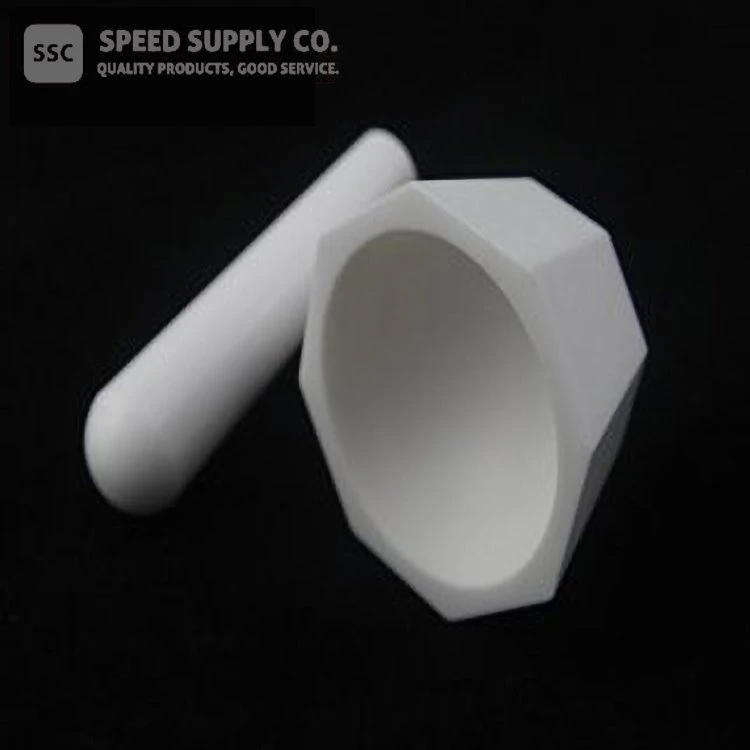
Features
Material: | Yttria Stabilized Zirconia, Magnesia Stabilized Zirconia, Calcia Stabilized Zirconia, Ceria Stabilised Zirconia, Zirconia Toughened Alumina, and Others |
Appearance: | White Solid |
Size: | Mortar 60 x 50 x 20 w/ Pestle |
Zirconia Mortar and Pestle Description
Zirconia is a crystalline solid that is white in colour, but can be produced in different colours to be used as an alternative gemstone to diamond or as ceramic dental crowns in medical applications. Naturally, it occurs as the translucent (sometimes transparent) mineral baddeleyite, a rare mineral that has a monoclinic prismatic crystal structure; i.e. a mineral having unequal vectors. Also known as "ceramic steel", this oxide of zirconium is chemically inert and is considered as one of the highly auspicious restorative materials, due to its excellent mechanical properties.
Out of all advanced ceramic materials, zirconia has the highest toughness and strength at room temperature. At high temperatures, zirconia may go through substantial change in volume during phase transformation. As a result, it is difficult to obtain stable zirconia products during sintering, which is why stabilisation of zirconia is generally required. Stabilised zirconia adds to the exceptional mechanical properties and chemical inertness a high level of chemical stability, even in harsh environments. Related materials include yttria-stabilised zirconia (YSZ), calcia-stabilised zirconia (CSZ), magnesia-stabilised zirconia (MSZ), etc.
Zirconia's high density, low porosity, inertness, toughness, and super hardness make it the perfect material for making mortars and pestles. Being approximately 10 on the Mohs hardness scale, zirconia mortar and pestles are able to grind materials which are too hard for agate, alumina, or porcelain. Our high wear-resistant mortar and pestle effectively eliminates product contamination and is chemically inert to acids and alkalis.
Typical Types of Zirconia
Material | Abbrev. |
Tetragonal Zirconia Polycrystals | TZP |
Partially Stabilised Zirconia | PSZ |
Fully Stabilised Zirconia | FSZ |
Transformation Toughened Ceramics | TTC |
Zirconia Toughened Alumina | ZTA |
Transformation Toughened Zirconia | TTZ |
Typical Properties of Zirconia
Property | Y-TZP | Ce-TZP | ZTA | Mg-PSZ | 3Y20A |
Density (g.cm-3) | 6.05 | 6.15 | 4.15 | 5.75 | 5.51 |
Hardenss (HV30) | 1350 | 900 | 1600 | 1020 | 1470 |
Bend Str. (MPa) | 1000 | 350 | 500 | 800 | 2400 |
Compressive Str. (MPa) | 2000 | - | - | 2000 | - |
Young's Modulus (GPa) | 205 | 215 | 380 | 205 | 260 |
Poisson's Ratio | 0.3 | - | - | 0.23 | - |
Fracture Toughness (MPa.m-1/2) | 9.5 | 15 - 20 | 4 - 5 | 8 - 15 | 6 |
Thermal Exp. Co-Eff (x10-6 °C-1) | 10 | 8 | 8 | 10 | 9.4 |
Thermal Conductivity (W.m-1.K-1) | 2 | 2 | 23 | 1.8 | 3 |
Zirconia Mortar and Pestle Applications and Related Industries
● Hard Materials
Zirconia's superior hardness allows it to grind tough ceramics such as aluminum oxide and silicon oxide
● Low Contamination Materials
When absolutely no contamination is tolerable, such as in ultra-pure organic, nanomaterial, and forensic applications, Zirconia is your best choice
● HF Applications
Zirconia's inertness to HF and other acids make it superior to Agate and other materials
● High-Temperature Applications
Zirconia's physical and thermal shock resistance lends it well to high-temperature applications
You Might Also Like


Send Inquiry
