

PRODUCTS
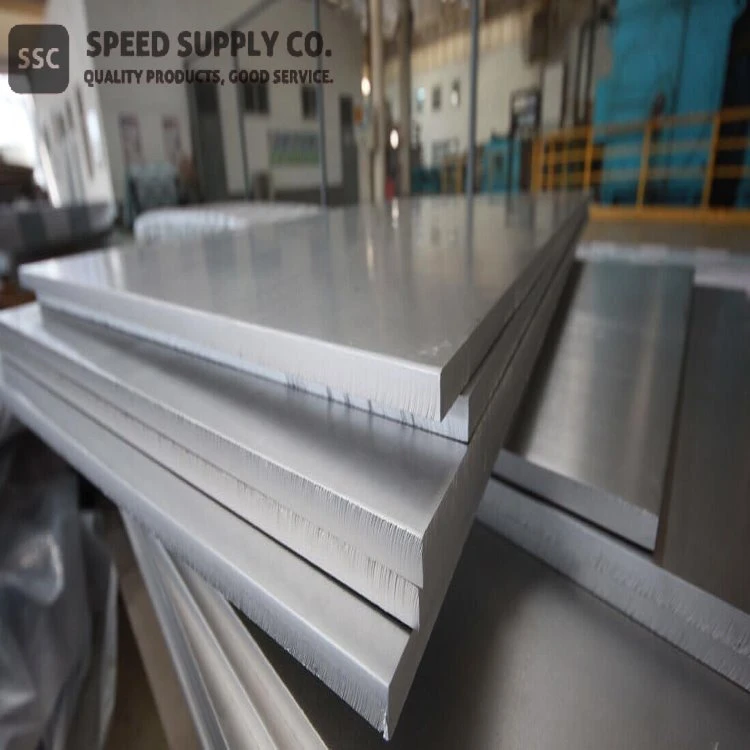
Features
Material: | C.P. Titanium, Titanium Alloy |
Standard: | ASTM B265, ASME SB265, AMS 4911, etc. |
Process: | Hot Rolled, Cold Rolled |
Shape: | Square Plate, Rectangular Sheet, Circular Shapes or according to drawings and specifications. |
Surface: | Pickled |
Size: | Thickness 5-100mm, Width 2500mm max, Length 6000mm max |
Titanium Plate Description
Pure titanium is characterized for its specific strength, reaching up to 590 MPa tensile strength. In alloy form, this strength extends dramatically up to 1250 MPa (exhibited in Grade Ti-15Mo-5Zr-3AI alloy).
Its fatigue strength is about half of its tensile strength, and does not decline when exposed to welding or when submerged in seawater.
Titanium is a suitable component for applications that require a unique mixture of strength and material lightness. Its density is 4.506 g/cm3 and its tensile strength is in the range of minimum 200 MPa to beyond 1300 MPa (varies depending on purity and alloy composition ).
Because pure titanium readily reacts with oxygen, it naturally produces an oxide film that gives itself protection against corrosive materials and environments. Its corrosion resistant against chlorine compounds, seawater, common acids, and extreme temperatures.
Titanium is also characterised by its refractory metal properties. Its melting point goes beyond 1650°C, significantly higher than aluminium and steel. Meanwhile, its coefficient of thermal expansion is 8.6 µm/(m·K), lower than steel and copper.
In the case of alloys, titanium is combined with aluminium, vanadium, tin, and/or palladium, among other metals. The variety of combinations creates a list of titanium grades under alpha and beta categories. Each grade is designed for specific applications based on the resulting properties.
Heat treatment further intensifies the strength of titanium alloy, particularly in terms of fatigue resistance, creep stability, and integrity against fracture. The conditions for heat treatment largely depend on the alloy composition in order to optimise the physical properties of the material.
Titanium plates are found in a variety of applications such as heat exchangers, various types of corrosive-resistant equipment, textile machinery and sporting equipment, etc.
SSC can also provide large cross-sectional area titanium blocks and other forged titanium parts, this will be ASTM B381 specified.
Size Range of Titanium Plate
Thickness (mm) | Width (mm) | Length (mm) |
5-8 | 2000 max | 4000 max |
8-100 | 2500 max | 6000 max |
Thickness (inches) | Width (inches) | Length (inches) |
0.20"-0.32" | 78.7" max | 157.5" max |
0.32"-3.94" | 78.7" max | 236.2" max |
Grades and Standards
Material Grade | Standard specification |
Commercially Pure | ASTM B 348 Grades 1,2,3,4 |
Ti Alloy 6Al 4V | ASTM B 348 Grade 5 |
Titanium Alloy 6Al 4V ELI | ASTM F 136 |
Titanium Alloy Ti 0.2Pd | ASTM B 348 Grades 7 & 11 |
Titanium Alloy Ti 0.3 Mo .8Ni | ASTM B 348 Grade 12 |
Titanium Alloy 5Al 2.5Sn | AMS 4953 |
Titanium Alloy 3Al 2.5V | ASTM B 348 Grade 9 |
Titanium Alloy Ti 6Al 7Nb | ASTM F 1295 |
Titanium Plate Applications and Related Industries
● Heat exchangers
● Corrosion-resistant equipment
● Textile machinery
● Sporting equipment
● Heating
● Equipment
● Machinery
Titanium Physical Properties
Grade | Ultimate Tensile Strength Min. | Yield Strength | Elongation % | Reduction Area % | Condition | ||
KSI | MPa | KSI | MPa | ||||
1 | 35 | 240 | 20 | 138 | 24 | 30 | As specified (shape) |
2 | 50 | 345 | 40 | 275 | 20 | 30 | As specified (shape) |
3 | 64 | 450 | 55 | 380 | 18 | 30 | As specified (shape) |
4 | 80 | 550 | 70 | 483 | 15 | 25 | As specified (shape) |
5 | 130 | 895 | 120 | 828 | 10 | 25 | As specified (shape) |
6 | 115 | 792 | 110 | 758 | 10 | 25 | Forged Bars |
7 | 50 | 345 | 40 | 275 | 20 | 30 | As specified (shape) |
9 | 90 | 620 | 70 | 483 | 15 | 25 | As specified (shape) |
11 | 35 | 240 | 20 | 138 | 24 | 30 | As specified (shape) |
12 | 70 | 483 | 50 | 345 | 18 | 25 | As specified (shape) |
16 | 50 | 345 | 40 | 275 | 20 | 30 | As specified (shape) |
17 | 35 | 240 | 25 | 170 | 24 | 30 | As specified (shape) |
23 | 120 | 828 | 110 | 759 | 10 | 25 | Beta-Annealed |
Titanium Material Grades
C.P. Titanium
Grade 1
Grade 2
Grade 2H (Grade 2 with 58 ksi minimum UTS)
Grade 3
Grade 4
Titanium Alloy
Grade 5 (6 % Al, 4 % V)
Grade 7 (0.12 to 0.25 % Pd)
Grade 7H (0.12 to 0.25 % Pd) (Grade 7 with 58 ksi minimum UTS)
Grade 9 (3 % Al, 2.5 % V)
Grade 11 (0.12 to 0.25 % Pd)
Grade 12 (0.3 % Mo, 0.8 % Ni)
Grade 13 (0.5 % Ni, 0.05 % Ru)
Grade 14 (0.5 % Ni, 0.05 % Ru)
Grade 15 (0.5 % Ni, 0.05 % Ru)
Grade 16 (0.04 to 0.08 % Pd)
Grade 16H (0.04 to 0.08 % Pd) (Grade 16 with 58 ksi minimum UTS)
Grade 17 (0.04 to 0.08 % Pd)
Grade 18 (3 % Al, 2.5 % V, 0.04 to 0.08 % Pd)
Grade 19 (3 % Al, 8 % V, 6 % Cr, 4 % Zr, 4 % Mo)
Grade 20 (3 % Al, 8 % V, 6 % Cr, 4 % Zr, 4 % Mo, 0.04 %–0.08 % Pd)
Grade 21 (15 % Mo, 3 % Al, 2.7 % Nb, 0.25 % Si)
Grade 23 (6 % Al, 4 % V, with extra low interstitial elements, ELI)
Grade 24 (6 % Al, 4 % V, 0.04 % to 0.08 % Pd)
Grade 25 (6 % Al, 4 % V, 0.3 % to 0.8 % Ni and 0.04 % to 0.08 % Pd)
Grade 26 (0.08 to 0.14 % Pd)
Grade 26H (0.08 to 0.14 % Pd) (Grade 26 with 58 ksi minimum UTS)
Grade 27 (0.08 to 0.14 % Pd)
Grade 28 (3 % Al, 2.5 % V, 0.08–0.14 % Ru)
Grade 29 (6 % Al, 4 % V, ELI, plus 0.08 to 0.14 % Ru)
Grade 30 (0.3 % Co, 0.05 % Pd)
Grade 31 (0.3 % Co, 0.05 % Pd)
Grade 32 (5 % Al, 1 % tin, 1 % Zr, 1 % V, 0.8 % Mo)
Grade 33 (0.4 % Ni, 0.015 % Pd, 0.025 % Ru, 0.15 % Cr)
Grade 34 (0.4 % Ni, 0.015 % Pd, 0.025 % Ru, 0.15 % Cr)
Grade 35 (4.5 % Al, 2 % Mo, 1.6 % V, 0.5 % iron, 0.3 % Si)
Grade 36 (45 % Nb)
Grade 37 (1.5 % Al)
Grade 38 (4 % Al, 2.5 % V, 1.5 % Fe)
You Might Also Like


Send Inquiry
