

PRODUCTS
Features
CAS Number: | 7440-25-7 |
Standard: | ASTM B521 |
Purity: | ≥99.9% or 99.95% |
Size: | Outer Diameter (OD): 0.2-8mm Wall Thickness (WT): 0.015-1mm Length (L): 1mm-1000mm |
Tolerance: | OD +/-0.003mm, WT +/-0.005mm, L +/-0.05mm |
Material Grades: | R05200, unalloyed tantalum, electron-beam furnace or vacuum-arc melt, or both R05400, unalloyed tantalum, powder-metallurgy consolidation. |
Tantalum Capillary Description
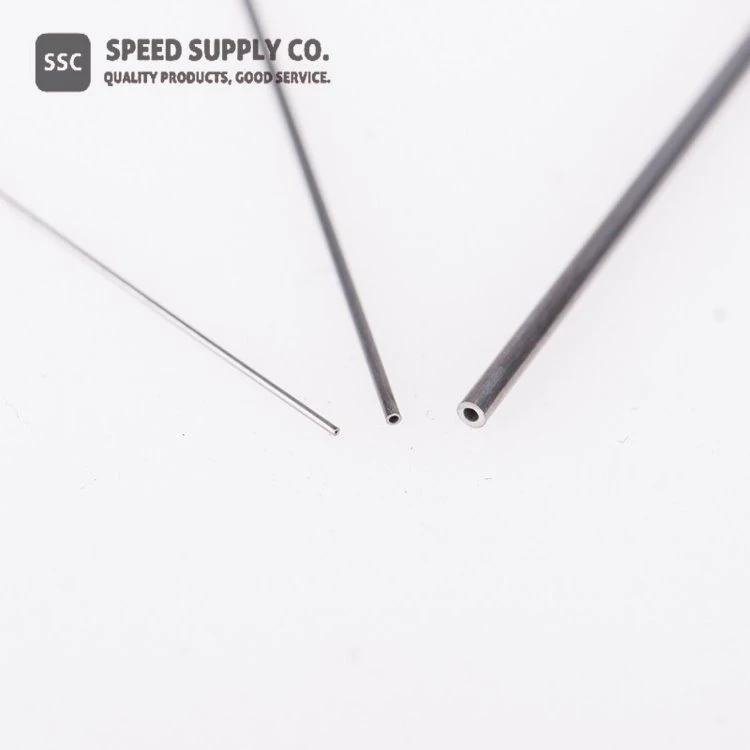
A tantalum capillary is a small, thin tube made of metal called tantalum. Tantalum is a rare, shiny metal that is resistant to corrosion.
Tantalum capillaries are designed to have a narrow internal diameter and a precise outer diameter, usually ranging from a few micrometers to a few millimeters. They are used in industries like chemical processing, medicine, and analytical instrumentation.
Tantalum tubes are very strong and can resist corrosion. Tantalum is resistant to strong acids and alkaline solutions. Tantalum capillaries can withstand harsh chemical environments and keep their structure intact over time.
Tantalum capillaries are corrosion resistant and have good mechanical properties. They are strong and hard, so they can handle mechanical stress and external pressure. Tantalum capillaries can be made to have different wall thicknesses, allowing the selection of a specific capillary size based on the application's requirements.
Tantalum capillaries also have a high melting point, which is around 3000°C (5432°F) Tantalum capillaries have a high melting point, making them suitable for applications that involve high-temperature environments.
Also, tantalum works well with the human body and is not harmful. Tantalum capillaries are suitable for medical and biomedical applications, such as implantable devices, catheters, and surgical instruments.
Tantalum tubes are great for handling liquids and analyzing things because they are small and have a smooth inside surface. They are used in chemical laboratories and analytical instrumentation as flow restrictors, sample introduction tubes, liquid chromatography columns, and microreactor.
Tantalum capillaries are good for applications that need to control fluid, resist chemicals, and work at high temperatures. They are resistant to corrosion, strong, and biocompatible.
Chemical Composition
Element | C | O | N | H | Fe | Mo | Nb | Ni | Si | Ti | W |
R05200 (%, Max) | 0.0006 | 0.012 | 0.001 | 0.0005 | 0.0022 | 0.002 | 0.01 | 0.0012 | 0.0029 | 0.0012 | 0.003 |
R05400 (%, Max) | 0.01 | 0.03 | 0.01 | 0.0015 | 0.01 | 0.02 | 0.1 | 0.01 | 0.005 | 0.01 | 0.05 |
Tantalum Capillary Applications and Related Industries
Tantalum capillaries are useful in many different industries because of their special properties. Here are some of the main applications where tantalum capillaries are used:
Chemical Processing: Tantalum capillaries are used in chemical processing industries for fluid control and containment. They are used in chemical reactors, separators, and analytical instruments to keep fluids pure and resist corrosive chemicals.
Medical and Biomedical: Tantalum capillaries are used in medicine and science because they are biocompatible and resistant to corrosion. They are used in medical devices, catheters, drug delivery systems, and analytical equipment for fluid handling and precise drug administration.
Analytical Instrumentation: Tantalum tubes are important for different types of tests like gas chromatography, liquid chromatography, and mass spectrometry. They are used as sample introduction tubes, capillary columns, and flow restrictors to make sure fluid is delivered accurately for precise analysis.
Aerospace and Defense: Tantalum capillaries are used in the aerospace and defense industries because they can handle high temperatures and resist corrosion. They are used in propulsion systems, fuel control systems, and fluid handling parts of aircraft and military equipment.
Semiconductor Manufacturing: Tantalum is used in semiconductor manufacturing processes. They help deliver chemicals and keep them clean and pure in processes like etching, cleaning, and deposition.
Research and Development: Tantalum capillaries are very important in research labs and schools. They are used in various experiments, microreactors, and fluid handling systems to control fluids for chemical reactions and analysis.
Energy and Nuclear: Tantalum capillaries are used in energy-related industries, including nuclear power plants and fuel cells. They are used in fluid handling systems and hydrogen purification processes where their corrosion resistance and high temperature stability are important.
Oil and Gas: Tantalum capillaries are used in the oil and gas industry because they resist corrosion. They are used in downhole applications and fluid analysis equipment to ensure accurate and reliable fluid handling and analysis.
Environmental Monitoring: Tantalum capillaries are used in environmental monitoring systems for analysing air and water samples. They are used in gas chromatography and liquid chromatography systems. They help put samples in and control the fluid so that the analysis is accurate.
Scientific Research: Tantalum capillaries are important for scientific research, including physics, chemistry, and materials science. They are used in fluidic systems and microfluidics to control and analyze fluids.
Tantalum capillaries are used in a number of different applications and related industries. They are good components for industries that need accurate fluid handling, chemical resistance, and reliability.
Chemical Identifiers
Linear Formula | Ta |
MDL Number | MFCD00011252 |
EC No. | 231-135-5 |
Beilstein/Reaxys No. | N/A |
Pubchem CID | 23956 |
SMILES | [Ta] |
InchI Identifier | InChI=1S/Ta |
InchI Key | GUVRBAGPIYLISA-UHFFFAOYSA-N |
Tantalum Capillary Properties (Theoretical)
Molecular Weight | 180.94 |
Appearance | Silvery-gray solid |
Melting Point | 3017 °C |
Boiling Point | 5458 °C |
Density | 16.69 g/cm3 (20 °C) |
Solubility in H2O | N/A |
Crystal Phase / Structure | α: body-centered cubic (bcc) / β: tetragonal |
Electrical Resistivity | 131 nΩ·m (20 °C) |
Electronegativity | 1.5 Paulings |
Heat of Fusion | 36.57 kJ/mol |
Heat of Vaporization | 753 kJ/mol |
Poisson's Ratio | 0.34 |
Specific Heat | 140 J/kg·K |
Thermal Conductivity | 57.5 W/m·K |
Thermal Expansion | 6.3 µm/m·K |
Vickers Hardness | 870–1200 MPa |
Young's Modulus | 186 GPa |
Hot Tags: tantalum metal capillary, China, suppliers, buy, for sale, made in China
You Might Also Like


Send Inquiry
