

PRODUCTS
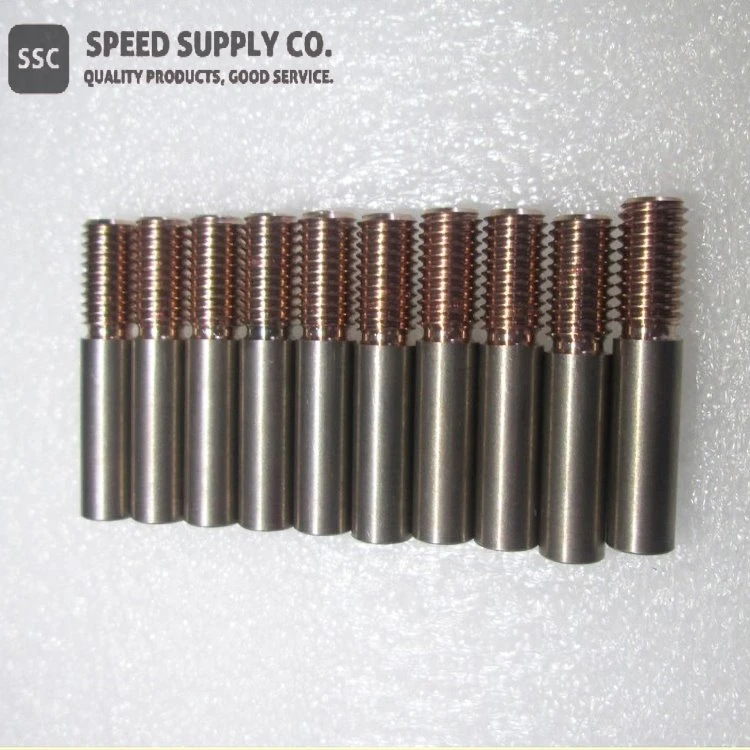
Features
CAS No.: | 64554-83-2 |
Linear Formula: | W-Cu |
Material: | Tungsten Copper Alloy |
Shape: | Electrode |
Size: | Customize |
Tungsten Copper Electrode Description
Tungsten copper is widely used in applications such as electrodes for sinker electrical discharge machining (EDM) and resistance welding. Tungsten copper EDM electrode is capable of machining hard refractory alloys such as titanium carbide and tungsten carbide. Tungsten copper can yield a better MMR (material removal rate) at a low level of TWR (tool wear rate) in comparison to copper, graphite, and other common materials electrodes. In addition, copper tungsten electrodes will become more desirable to utilize if the machining work requires high accuracy in dimension or an intricated geometry.
Tungsten copper EDM electrodes manifest excellent EDM performance when machining carbide tungsten. They are preferable than copper electrodes for use in many micro EDM machining processes such as small hole drilling to specific materials. Infiltrated tungsten copper, sintered and pressed by powder metallurgy, has an integral microstructure. EDM's electrodes with a uniform structure can yield high-quality roughness on the workpiece surface.
High tungsten content imparts both high melting point and density to copper tungsten EDM electrodes. Thus, tungsten provides the electrode a solid spark erosion resistance. Copper tungsten EDM electrode's 20%-40% copper content is largely responsible for its excellent conductivity. High electrical and thermal performance is essential to maintaining an electrode's material removal rate, which determines its cutting speed.
Tungsten copper is a relatively cost-saving and efficient option with respect to overcoming machining difficulties caused by a high melting temperature, and high thermal shock and abrasion resistance. Tungsten copper composites are also a preferred gourp of material in resistance welding electrodes. This is both because of the excellent conductivity of copper and the high melting point and the corrosion resistance of tungsten.
Specification of Tungsten Copper Electrode
Item# | Composition | Density (g/cm3) | Hardness (HRB) | Electric Conductivity (%IACS) |
30W70Cu | W: 30%, Cu: 70% | 10.32 | 42 | 89 |
35W65Cu | W: 35%, Cu: 65% | 10.66 | 50 | 82 |
40W60Cu | W: 40%, Cu: 60% | 11.02 | 55 | 77 |
45W55Cu | W: 45%, Cu: 55% | 11.42 | 61 | 73 |
40W60Cu | W: 50%, Cu: 50% | 11.9 | 65 | 54 |
55W45Cu | W: 55%, Cu: 45% | 12.5 | 70 | 49 |
60W40Cu | W: 60%, Cu: 40% | 13.3 | 76 | 47 |
70W30Cu | W: 70%, Cu: 30% | 13.9 | 82 | 44 |
75W25Cu | W: 75%, Cu: 25% | 14.5 | 88 | 42 |
80W20Cu | W: 80%, Cu: 20% | 15.2 | 100 | 38 |
85W15Cu | W: 85%, Cu: 15% | 16.1 | 240HB | 33 |
90W10Cu | W: 90%, Cu: 10% | 16.9 | 260HB | 28 |
Tungsten Copper Electrode Applications and Related Industries
● High-speed spot welding of wire harnesses for use in motors, automobiles, and anywhere complex or simple wire harnesses are used
● Line switches for battery packs
● Electrical components for manufacturing lines of circuit breakers and electrical switches
● Automotive
Chemical Identifiers
Linear Formula | WCu |
MDL Number | N/A |
EC No. | N/A |
Beilstein/Reaxys No. | N/A |
Pubchem CID | 57449491 |
IUPAC Name | copper; tungsten |
SMILES | [Cu].[W |
InchI Identifier | InChI=1S/Cu.W |
InchI Key | SBYXRAKIOMOBFF-UHFFFAOYSA-N |
Tungsten Copper Electrodes Properties (Theoretical)
Compound Formula | WCu |
Molecular Weight | 247.39 |
Appearance | Solid |
Melting Point | N/A |
Boiling Point | N/A |
Density | 13-16 g/cm3 |
Solubility in H2O | N/A |
Exact Mass | 246.880529 |
Monoisotopic Mass | 246.880529 |
You Might Also Like


Send Inquiry
