

PRODUCTS
Features
CAS No.: | 1304-56-9 |
Linear Formula: | BeO |
Material: | Beryllium Oxide |
Purity: | 97%, 99% |
Appearance: | White Solid |
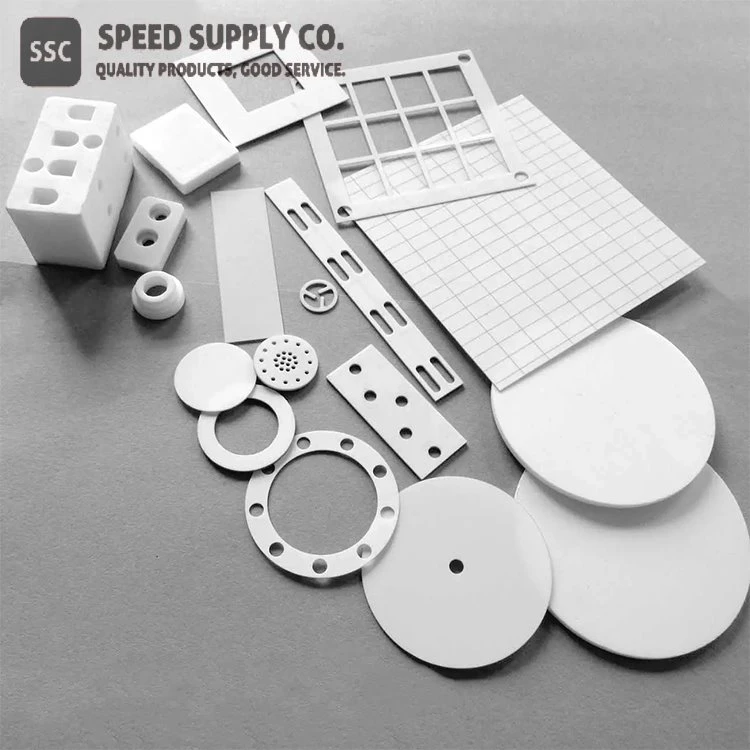
Shape: | Rod, Tube, Plate, Sheet, Disc, and Customized Parts |
Size: | Customized |
Processing Methods: | Cold Isostatic Press, Dry Press, Tape Casting, Precision Machining Processing, etc. |
Beryllia Ceramics Description
Beryllium oxide (BeO), which is commonly referred to as beryllia, is endowed with a virtuously unique combination of thermal, electrical, optical, and mechanical properties which may be exploited for a diverse range of applications.
BeO provides all the desirable physical and dielectric characteristics exhibited by aluminum oxide or aluminum nitride and, in addition, offers thermal conductivity ten times higher than alumina, and fifty percent higher than aluminum nitride, a dielectric constant that is lower than both alumina and aluminum nitride, and weight per given volume that is fully a quarter less than alumina, and nearly ten percent less than aluminum nitride. As a thermally conductive and electrically insulating material, its performance is exceeded only by that of diamond.
Although high-purity beryllium oxide ceramics are very safe, it cannot be ignored that beryllium oxide dust is toxic to the human body. This is like plastics that do not produce toxins when they are used, but the materials made of plastics are generally toxic for the same reason. Beryllium oxide ceramics processed into solid forms will not cause special harm to human health.
Characteristics of Beryllia Ceramics
● Apart from reactivity with water vapor at high temperature (1000°C), BeO is one of the most chemically stable oxides, resisting both carbon reduction and molten metal attack at high temperatures.
● The thermal conductivity of BeO is extremely high in comparison with other ceramics, particularly below 300°C. For comparison, the thermal conductivity of Beryllium Oxide at Room Temperature is 285 W/mK, for copper it is 400 W/mK, for aluminum nitride it is 180 W/mK, and for diamond it is 2000 W/mK.
● BeO is classified as an electrical insulator with a bulk Resistivity on the order of 1016Ωcm.
● The mechanical strength is normally lower than that of alumina. Its fracture toughness is generally about half that of alumina; but with good design and controlled fabrication processing acceptable strength can be achieved for commercial applications of BeO.
● BeO has relatively very good thermal shock resistance due to its high thermal conductivity.
● Beryllium oxide has a density fully 25% lower than Alumina. Comparing theoretical density values, BeO is 3.01g/cc while Al2O3 is 4.00 g/cc and AlN is 3.26 g/cc.
● The coefficient of thermal Expansion for BeO is comparable to many other oxide ceramics and many metals, as well, at approximately 7.5 in./in./°C for the range from 25°C - 1000°C.
Mechanical Properties of Beryllia Ceramics
Properties | Unit | 97%BeO | 99%BeO | 99%Al2O3 |
Colour | —— | White | White | Yellow |
Density | g/cm³ | ≥2.85 | ≥2.85 | 3.85 |
Flexural Strength | MPa | ≥170 | ≥190 | 310 |
Air Tightness | Pa.m³/s | ≤10×10-11 | ≤10×10-11 | —— |
Average Grain Size | um | 12~30 | 12~30 | —— |
Thermal Properties of Beryllia Ceramics
Properties | Unit | 97%BeO | 99%BeO | 99%Al2O3 |
Maximum Use Temperature | ℃(No load) | 1600 | 1600 | 1650 |
Thermal Conductivity @ 25°C | W/(m・K) | ≥200 | ≥240 | 29 |
Thermal Conductivity @ 100°C | W/(m・K) | ≥160 | ≥190 | —— |
Thermal Expansion a at 25–500°C | 1 x 10⁻⁶/°C | 7~8.5 | 7~8.5 | 7~8 |
Thermal Shock Resistance | ℃(Put in water) | 800 | 800 | 200 |
Electrical Properties of Beryllia Ceramics
Properties | Unit | 97%BeO | 99%BeO | 99%Al2O3 |
Dielectric Constant | 1MHz | 6.9±0.4 | 6.9±0.4 | 9.9 |
Dielectric Strength | KV/mm | 50 | 50 | 15 |
Dielectric Loss | 1MHz | 4 x 10⁻⁴ | 4 x 10⁻⁴ | 4 x 10⁻⁴ |
Volume Resistivity @ 25°C | Ω・cm | >1014 | >1014 | >1014 |
Volume Resistivity @ 300°C | Ω・cm | >1011 | >1011 | >108 |
Beryllia Ceramics Applications and Related Industries
● Medical: gas lasers for DNA and tissue analysis, confocal and wide field fluorescence microscopy equipment, portable defibrillators, telecom infrastructure, transistors and terminations in the wireless system
● Lasers: high end laser diodes for commercial systems, industrial laser metal cutting and marking equipment, long range fiber optic transmission
● Semiconductor Handling Equipment: end-effectors and arm components, wafer chucks, crucibles for high temperature melting
● Energy: oil and gas exploration, in situ x-ray analysis for down-hole drilling, concentrating photovoltaic (CPV) systems optoelectronics, transmitters, receivers, modulators, and switches, power amplifiers and drivers
● Military and Aerospace: radar modules, guidance modules, microwave and millimeter-wave communications modules
● Wireless Communications: point-to-point and point-to-multipoint radios, satellite communication modules
Chemical Identifiers
Linear Formula | BeO |
MDL Number | MFCD00003457 |
EC No. | 215-133-1 |
Beilstein/Reaxys No. | N/A |
Pubchem CID | 14775 |
IUPAC Name | Oxoberyllium |
SMILES | [Be]=O |
InchI Identifier | InChI=1S/Be.O |
InchI Key | LTPBRCUWZOMYOC-UHFFFAOYSA-N |
Beryllium Oxide Properties (Theoretical)
Compound Formula | BeO |
Molecular Weight | 25.01 |
Appearance | White powder |
Melting Point | 2507 °C (4545 °F) |
Boiling Point | 3900 °C (7052 °F) |
Density | 2.9 g/cm3 |
Solubility in H2O | N/A |
Electrical Resistivity | 13 10x Ω-m |
Poisson's Ratio | 0.26 |
Specific Heat | 1050 J/kg-K |
Tensile Strength | 140 MPa (Ultimate) |
Thermal Conductivity | 270 W/m-K |
Thermal Expansion | 8.0 µm/m-K |
Young's Modulus | 350 GPa |
Exact Mass | 25.0071 |
Monoisotopic Mass | 25.007097 Da |
Beryllium Oxide Health & Safety Information
Signal Word | Danger |
Hazard Statements | H301-H315-H317-H319-H330-H335-H350i-H372 |
Hazard Codes | T+ |
Precautionary Statements | P201-P260-P280-P284-P301 + P310-P305 + P351 + P338 |
Flash Point | Not applicable |
Risk Codes | 49-25-26-36/37/38-43-48/23 |
Safety Statements | 53-45 |
RTECS Number | DS4025000 |
Transport Information | UN 1566 6.1 / PGII |
WGK Germany | 3 |
GHS Pictograms | GHS06 Skull and Crossbones
GHS08 Health Hazard
|


You Might Also Like


Send Inquiry
