

PRODUCTS
Features
|
CAS Number: |
7440-03-1 |
|
Standard: |
ASTM B393-05 |
|
Purity: |
99.9%, 99.95%, 99.99% |
|
Size: |
Thickness 0.03-0.09mm, Width 30-300mm, Length>50mm |
|
Surface: |
Polished |
|
Material Grade: |
R04200-Type 1 -Reactor grade unalloyed niobium R04210-Type 2 -Commercial grade unalloyed niobium |
Product Description
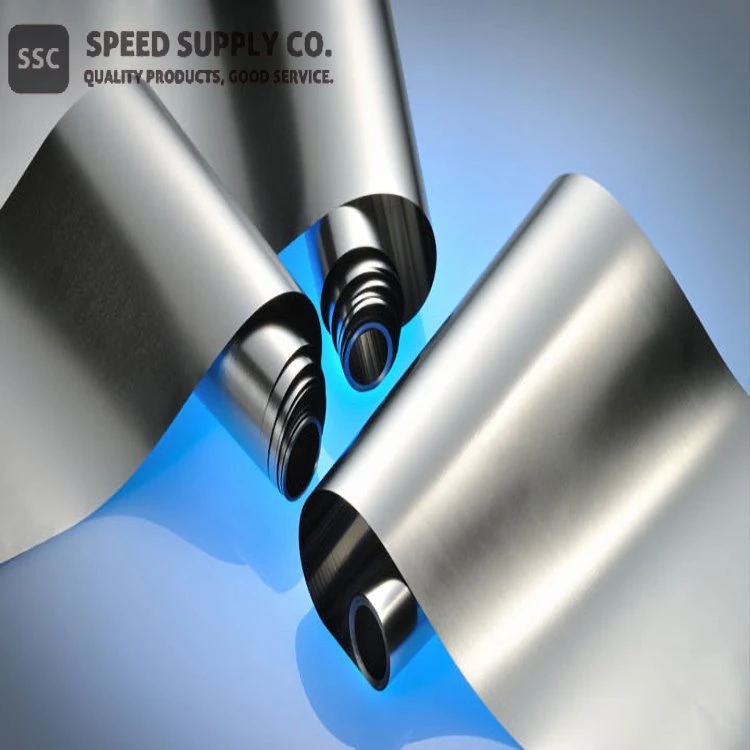
Niobium foil and strip are thin sheets of high-purity niobium metal, produced by rolling or cold-working niobium ingots into extremely thin and uniform thicknesses. These forms of niobium are widely utilized in various advanced industries due to their exceptional properties, including high temperature resistance, corrosion resistance, and superconductivity. Niobium foil and strip are often used in the aerospace, electronics, and energy sectors, particularly in applications where precision, high-performance materials, and lightweight solutions are required.
Niobium foil and strip are available in a range of thicknesses and widths, with excellent mechanical properties and high structural integrity. These materials are also used in the manufacture of superconducting magnets, medical devices, and high-performance capacitors. Additionally, niobium's biocompatibility makes it suitable for medical implants, and its high strength-to-weight ratio makes it ideal for aerospace applications.
Features and Properties
High Melting Point: Niobium's melting point of 2,468°C (4,474°F) makes it a reliable material for high-temperature applications.
Corrosion Resistance: It offers outstanding resistance to oxidation and corrosion, especially in acidic and alkaline environments.
Superconductivity: Niobium-based materials are essential for the creation of superconducting magnets, commonly used in MRI machines and other scientific applications.
High Strength-to-Weight Ratio: Niobium foil and strip provide a combination of lightweight and high strength, making them ideal for aerospace components.
Excellent Formability: Despite its strength, niobium is highly ductile, allowing it to be easily fabricated into thin foils and strips without compromising its mechanical properties.
Non-toxic and Biocompatible: Niobium is safe to use in medical and biological applications, making it suitable for implants and medical devices.
Thermal Conductivity: Niobium's excellent thermal conductivity makes it ideal for use in heat management applications, including electronic devices.
Product Specifications
Chemical Composition: Niobium (Nb)
Purity: 99.5% to 99.9%
Density: 8.57 g/cm³
Melting Point: 2,468°C (4,474°F)
Hardness: 200–300 HV (Vickers hardness)
Color: Silver-gray, metallic luster
Form: Flat foil or strip, which can be further fabricated into other shapes or components.
Product Standards
ASTM B393: Standard Specification for Niobium and Niobium Alloy Strip, Sheet, and Plate
ISO 9001: Certified for quality management systems
RoHS Compliant: Free from hazardous substances, ensuring compliance with environmental regulations
UL Certified: Meets safety standards for industrial applications.
Product Forms
Niobium Foil: Thin sheets of niobium that can be produced in various thicknesses and lengths.
Niobium Strip: Narrow, elongated forms of niobium, ideal for applications that require precision and accuracy.
Custom Sizes: Available in customized widths, lengths, and thicknesses according to customer requirements.
Rolls or Coils: Niobium foil and strip can also be rolled into coils for easier handling, storage, and shipping.
Production Method and Production Equipments
Production Methods:
Rolling: Niobium ingots are first heated and then passed through rolling mills to reduce the thickness and produce flat, thin sheets of niobium foil.
Cold Rolling: Cold rolling is applied to reduce the thickness further while maintaining dimensional accuracy and surface finish.
Annealing: The foil or strip may undergo annealing to relieve internal stresses, improve ductility, and enhance workability.
Laser Cutting: For precision shaping and trimming, laser cutting may be used to produce exact dimensions or custom shapes for specific applications.
Production Equipments:
Rolling Mill: Used for reducing the thickness of niobium ingots into foil and strip forms.
Cold Rolling Mill: Cold rolling is used to refine the thickness of niobium and ensure smooth, uniform surfaces.
Annealing Furnace: Niobium foil and strip may undergo heat treatment in an annealing furnace to improve ductility and workability.
Laser Cutter: Used for high-precision cutting of foil and strip to customer specifications.
Cutting Machine: Mechanical cutting machines may also be used for custom dimensions and profiles.
Applications and Related Industries
Aerospace: Niobium foil and strip are used in high-performance components such as turbine blades, jet engines, and rocket nozzles, where heat resistance and strength are essential.
Electronics: Niobium is widely used in electronic devices like capacitors and resistors due to its stable electrical properties.
Energy: Niobium foil and strip are used in energy generation applications, including nuclear reactors and superconducting magnets used in energy storage systems.
Medical: Due to its biocompatibility, niobium is used in medical implants, stents, and other devices that require corrosion resistance and safety for long-term use.
Steel and Alloy Production: Niobium is used in producing high-strength, low-alloy steels and superalloys for industrial and military applications.
Scientific Research: Niobium-based alloys are used in research environments, including particle accelerators and scientific instrumentation that require superconductivity.
Interesting Facts
Superconducting Materials: Niobium is essential in the production of superconducting magnets, including those used in MRI (Magnetic Resonance Imaging) machines and other medical devices.
Aerospace Use: Niobium's strength-to-weight ratio makes it ideal for aerospace applications, including in the production of turbine blades and rocket components.
High-temperature Applications: Niobium maintains its structural integrity even at high temperatures, making it indispensable in applications like jet engines and nuclear reactors.
Sustainable Metal: Niobium is fully recyclable, contributing to the sustainability of industries that use it.
Ancient Material: Niobium was first discovered in 1801 by the British chemist Charles Hatchett, and since then, its unique properties have led to its widespread use in advanced technologies.
Synonyms
Niobium Metal Foil
Niobium Strip
Nb Foil
Nb Strip
Niobium Alloy Foil and Strip
Health & Safety Information
Handling and Storage:
Niobium foil and strip should be stored in a cool, dry, and well-ventilated environment.
Store away from moisture, heat sources, and direct sunlight to maintain the material's integrity.
Wear appropriate personal protective equipment (PPE) such as gloves, safety goggles, and protective clothing when handling niobium foil and strip.
When machining or grinding, use dust collection systems to prevent inhalation of fine particles.
Disposal:
Niobium is non-toxic and can be recycled, making it an environmentally friendly material.
Dispose of any waste in accordance with local environmental regulations, although niobium itself does not pose any significant environmental hazards.
Why Choose Us for Your Niobium Foil and Strip Needs?
High Purity: Our niobium foil and strip are manufactured with the highest purity standards, ensuring they meet the rigorous demands of your applications.
Custom Sizes: We offer niobium foil and strip in a variety of thicknesses and widths to meet your exact specifications.
Global Shipping: We provide fast, reliable shipping worldwide, ensuring your order reaches you on time.
Competitive Pricing: We offer competitive pricing for niobium foil and strip, ensuring that you get top-quality materials at a cost-effective price.
Expert Technical Support: Our team is available to assist you with selecting the right niobium products for your specific needs, providing support for all stages of your project.
For more information or to place an order, please contact us today!
Chemical Composition
|
Composition% |
||||||||||||
|
Material |
Main Content |
Impurities (no more than %) |
||||||||||
|
Nb |
Fe |
Si |
Ni |
W |
Mo |
Ti |
Ta |
O |
C |
H |
N |
|
|
R04200 |
Remaining |
0.004 |
0.004 |
0.002 |
0.005 |
0.005 |
0.002 |
0.05 |
0.012 |
0.0035 |
0.0012 |
0.003 |
|
R04210 |
Remaining |
0.01 |
0.01 |
0.005 |
0.02 |
0.01 |
0.004 |
0.07 |
0.015 |
0.0050 |
0.0015 |
0.005 |
Physical Property
|
Grade |
Tensile strength, psi (MPa), ≥ |
Yield strength (0.2% offset), psi (MPa), ≥ |
Elongation in 1" gage length, %, ≥ |
|
|
>=0.010" |
<0.010" |
|||
|
R04200, R04210 |
18000 (125) |
10500 (73) |
20 |
15 |
Chemical Identifiers
|
Linear Formula |
Nb |
|
MDL Number |
MFCD00011126 |
|
EC No. |
231-113-5 |
|
Beilstein/Reaxys No. |
N/A |
|
Pubchem CID |
23936 |
|
SMILES |
[Nb] |
|
InchI Identifier |
InChI=1S/Nb |
|
InchI Key |
GUCVJGMIXFAOAE-UHFFFAOYSA-N |
Niobium Foil and Strip Properties (Theoretical)
|
Molecular Weight |
92.9 |
|
Appearance |
solid |
|
Melting Point |
2468 °C |
|
Boiling Point |
4742 °C |
|
Density |
8.57 g/cm3 |
|
Solubility in H2O |
N/A |
|
Electrical Resistivity |
12.5 microhm-cm @ 0 °C |
|
Electronegativity |
1.6 Paulings |
|
Heat of Vaporization |
N/A |
|
Poisson's Ratio |
0.4 |
|
Specific Heat |
0.064 Cal/g/K @ 25 °C |
|
Tensile Strength |
N/A |
|
Thermal Conductivity |
0.537 W/cm/K @ 298.2 K |
|
Thermal Expansion |
7.3 µm/(m·K) |
|
Vickers Hardness |
1320 MPa |
|
Young's Modulus |
105 GPa |
Hot Tags: niobium foil and strip, China, suppliers, buy, for sale, made in China
You Might Also Like


Send Inquiry
